

22.06.2026
New Genomic Test Reveals Hidden Drug-Resistant Tuberculosis in Eswatini
Targeted sequencing identifies dangerous tuberculosis strains missed by routine diagnostic tests and informs life-saving treatment decisions
Researchers in Eswatini have demonstrated that advanced genomic testing can uncover highly drug-resistant tuberculosis (TB) strains that frequently evade routine diagnostic methods, highlighting a major challenge for TB control and treatment in Southern Africa.
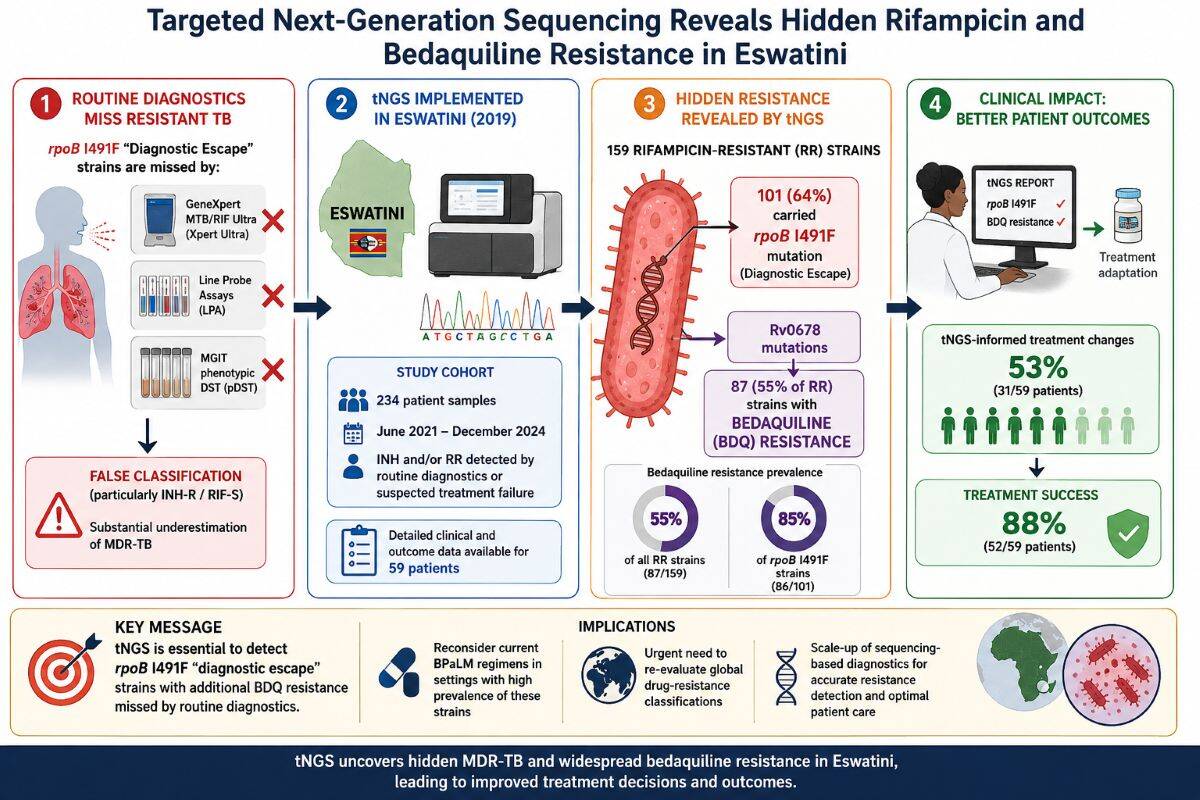
The study evaluated the implementation of targeted next-generation sequencing (tNGS) as part of routine TB care in Eswatini, a country facing a high burden of multidrug-resistant tuberculosis (MDR-TB). The findings reveal that standard diagnostic tests often fail to detect a particularly problematic form of rifampicin-resistant TB caused by the rpoB I491F mutation, leading to substantial underestimation of drug resistance and potentially inappropriate treatment.
“Accurate detection of drug resistance is essential for successful tuberculosis treatment,” said the study investigators. “Our results show that many patients classified as having less severe forms of resistance actually carried multidrug-resistant strains that were missed by conventional diagnostic methods.”
Hidden resistance revealed
Between June 2021 and December 2024, researchers analysed 234 patient samples from individuals with suspected drug-resistant TB or treatment failure. Using tNGS, the team identified rifampicin resistance in 159 TB strains. Remarkably, nearly two-thirds of these strains carried the rpoB I491F rifampicin resistance mutation, a well-known “diagnostic escape” mutation that is poorly detected by several widely used diagnostic assays.
Even more concerning, the study found high levels of resistance to bedaquiline, one of the most important drugs used in modern MDR-TB treatment regimens. Genetic markers associated with bedaquiline resistance were detected in more than half of all rifampicin-resistant strains and in 85% of strains carrying the rpoB I491F mutation.
“These findings suggest that a substantial proportion of patients may be receiving treatment regimens that include drugs to which their infecting strain is already resistant,” the researchers noted.
Direct impact on patient care
The introduction of tNGS had an immediate clinical impact. Sequencing results prompted treatment modifications in more than half of the patients for whom detailed clinical information was available. Despite the complexity of the resistance patterns observed, treatment success was achieved in 88% of these patients, demonstrating the value of comprehensive resistance testing for guiding individualized therapy.
Contact

Dr. Debrah Vambe
Baylor College of Medicine Children’s Foundation Eswatini
Mbabane, Eswatini
Department of Pediatrics, Global TB Program
Baylor College of Medicine, Houston, TX, USA
Email: Debrah.Vambe@bcm.edu
Implications for global TB control
The study raises important questions about current approaches to diagnosing and classifying drug-resistant TB. Because routine diagnostic tools may fail to identify rpoB I491F-associated rifampicin resistance, patients can be incorrectly classified and treated. The frequent co-occurrence of rifampicin and bedaquiline resistance also challenges the effectiveness of standardized treatment regimens such as BPaLM in settings where these strains are prevalent.
The researchers argue that broader implementation of sequencing-based diagnostics could significantly improve the detection of drug resistance and help prevent treatment failure, ongoing transmission, and the further emergence of resistance.
As countries increasingly adopt genomic technologies for infectious disease surveillance, the experience from Eswatini demonstrates how targeted sequencing can close critical diagnostic gaps and support more effective, personalized TB care.
Key findings
- Targeted next-generation sequencing identified rifampicin resistance in 159 TB strains.
- Sixty-four percent of rifampicin-resistant strains carried the diagnostic escape mutation rpoB I491F.
- Bedaquiline resistance-associated mutations were detected in 55% of rifampicin-resistant strains.
- Routine diagnostic tests substantially underestimated the burden of multidrug-resistant TB.
- Sequencing results led to treatment changes in 53% of patients.
- Treatment success was achieved in 88% of patients with available outcome data.
The findings underscore the growing importance of genomic technologies for tuberculosis diagnosis, surveillance, and treatment, particularly in regions where highly drug-resistant strains continue to emerge and spread.
Participating Institutions
The study was conducted through an international collaboration involving researchers from the Baylor College of Medicine Children’s Foundation Eswatini (Mbabane, Eswatini), the Global TB Program at Baylor College of Medicine (Houston, USA), the National Tuberculosis Reference Laboratory, Eswatini Health Laboratory Services, Ministry of Health (Mbabane, Eswatini), the National TB Control Program (Manzini, Eswatini), and the Research Center Borstel, Leibniz Lung Center (Germany), together with additional partner institutions from Eswatini, Europe, and the United States.
Funding
The study was supported by the German Federal Ministry of Health (Global Health Protection Programme, GHPP), the German Center for Infection Research (DZIF), the German Research Foundation (DFG), the German Federal Ministry of Education and Research (BMBF), and the U.S. National Institutes of Health (NIH).
Publication
Vambe, D., Kay, A., Ziyane, M. et al. Targeted next-generation sequencing implementation in Eswatini identifies rifampicin and bedaquiline resistance undetected by routine diagnostic testing. Nature Communications (2026). https://doi.org/10.1038/s41467-026-73551-w