

03.06.2026
Funding approved for innovative microfluidics project
The research group ‘Biophysics’ at the Research Center Borstel, Leibniz Lung Center (FZB) has some great news to celebrate: Last week, the “Leibniz Health Technologies” research network approved a feasibility study proposed by Dr Christian Nehls (FZB) in collaboration with Dr Anja Silge (Leibniz Institute of Photonics, IPHT) and Prof Miriam Agler-Rosenbaum (Leibniz Institute for Natural Product Research and Infection Biology, HKI).
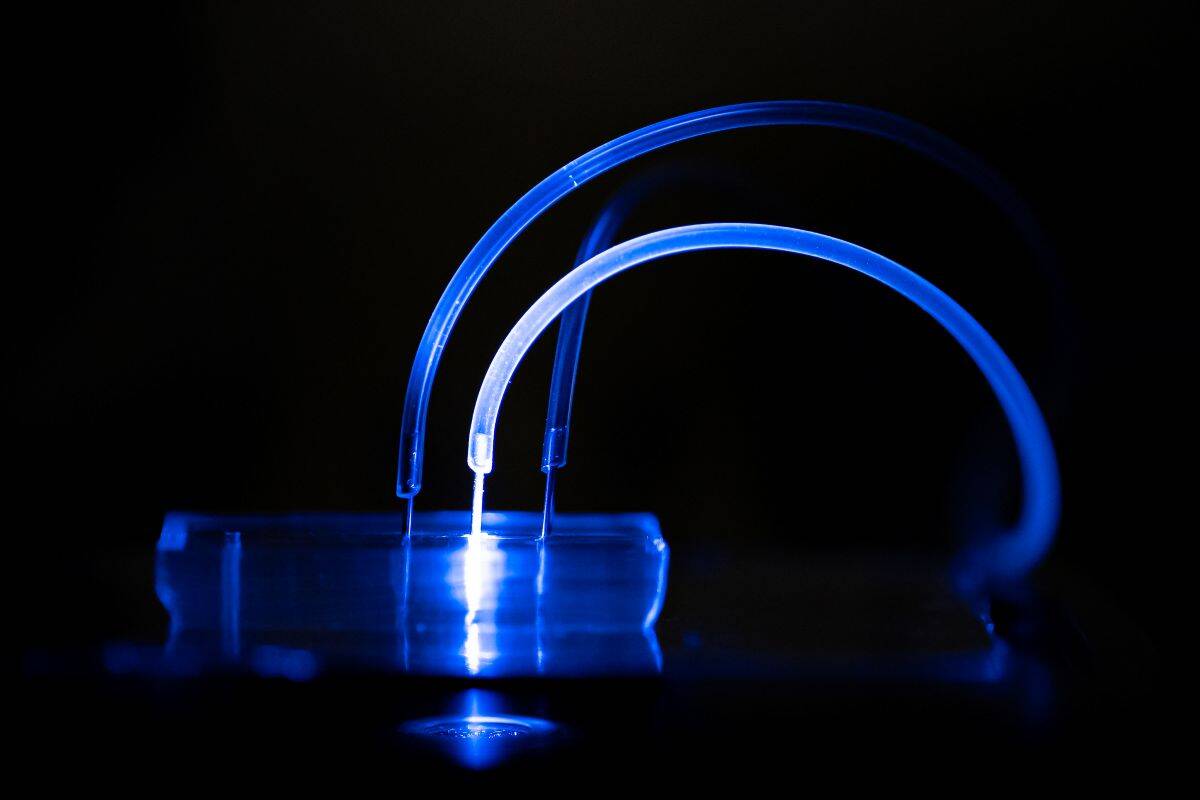
The project centres on the “SynerChip”, an innovative microfluidic chip designed to precisely and quantitatively measure the mutual enhancement of active substances. Microfluidic chips are miniaturised laboratory systems in which tiny quantities of liquid can be precisely controlled and analysed through a network of wafer-thin channels. They enable biological and chemical experiments to be carried out in a fraction of the time and with a fraction of the quantities of substances required in conventional laboratory procedures.
The aim is to find new ways to combat bacterial infections more effectively through intelligent combinations of active substances. The feasibility study will specifically investigate how novel antimicrobial peptides developed at the FZB can enhance the efficacy of antibiotics. This is a promising approach in view of the growing global threat posed by antibiotic resistance.
The interdisciplinary collaboration between the FZB, the Leibniz-IPHT and the HKI brings together expertise in biophysics, photonics and infection biology. In the long term, the aim is to use the data obtained to develop predictive models that will enable the effectiveness of drug combinations to be assessed much more quickly and reliably in future.
The total funding amounts to €38,921, of which €34,821 will go to the FZB. A significant portion of the funds will be used to continue funding a research assistant for six months, who will support the project. The project will run from 1 July to 31 December 2026.
Britta Weller
Further Information: